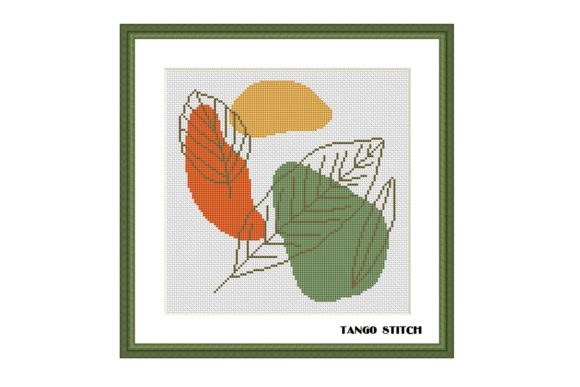
Abstract Leaves Cross Stitch Pattern
A Practical Review for Small Business Merchandise & Branded Patches
As an embroidery designer who’s developed hundreds of commercial patterns for cafés, florists, boutiques, and handmade brands, I approached the Abstract Leaves Cross Stitch Pattern with a very specific question: *Does this translate beyond craft hobby use into professional, scalable brand assets?* The answer is a qualified yes—but only when applied intentionally. Let’s break down why.
First Impression: Friendly, Modern, and Handmade—Without Looking Amateur
The title alone—Abstract Leaves Cross Stitch Pattern—immediately signals approachability and organic energy. Paired with “Cute flower embroidery design” and “Tango Stitch Easy cross stitch design,” it reads as warm, contemporary, and intentionally unpolished in the best way: like a signature hand-drawn logo, not a clipart afterthought. It avoids cliché botanical rigidity while retaining botanical clarity—ideal for businesses that want to feel grounded, creative, and human-centered. Think: a neighborhood bakery’s apron embroidery, a florist’s tote bag design, or a pet brand’s embroidered patch on reusable bandanas.
Real-World Performance Across Business Applications
This pattern shines where small-scale, high-character branding matters most. As a machine embroidery design, its reliance on full stitches (no fractional or backstitch outlines) makes it exceptionally stable across fabric types—especially important for custom apparel like staff uniforms and café aprons. On cotton twill or canvas tote bags, the clean geometry of the abstract leaves holds up beautifully at 2.5"–3.5" widths—the sweet spot for chest logos and sleeve accents.
For embroidered patch production, the design scales well down to 1.75" without losing legibility—critical for cap fronts and lapel patches. Its open negative space prevents over-stuffing during embroidery, reducing stitch density pressure on stabilizer and minimizing puckering on curved surfaces like baseball caps. That’s a major win for shops doing cap embroidery in-house or outsourcing to contract digitizers.
It also works seamlessly as a printable mockup asset: the balanced composition and clear silhouette make it easy to drop into branded packaging, product labels, or digital storefronts—strengthening visual consistency across both physical and online touchpoints.
Where to Use With Intention—Not Assumption
Don’t assume this pattern is universally flexible. Because it’s built for cross stitch—not machine embroidery by default—it requires careful adaptation before commercial use. Here’s where caution applies:
- Small patch sizes under 1.5": Fine detail may blur; test stitch-out first.
- Dark uniforms or textured fabric: Low-contrast thread colors (e.g., light green on charcoal) can disappear—always verify thread color contrast against your base fabric.
- Frequent-wash items: While full stitches are durable, tight leaf clusters may benefit from lightweight cutaway stabilizer to prevent thread migration over time.
- Curved surfaces (like cap fronts): Confirm hoop size compatibility—some versions may require slight simplification to avoid distortion.
How It Strengthens Brand Identity—Not Just Decoration
Unlike generic floral motifs, the Abstract Leaves Cross Stitch Pattern communicates intentionality. Its abstraction invites interpretation without sacrificing recognition—making it memorable yet versatile. For a small business, that means customers associate the motif with your values: thoughtfulness, craftsmanship, quiet confidence. It elevates small business merch from “cute add-on” to intentional brand extension.
When stitched onto aprons or tote bags, it subtly reinforces authenticity—especially for handmade product sellers on Etsy or local markets. Buyers don’t just see a leaf; they register care, attention to materiality, and alignment with tactile, human-made quality. That builds trust faster than stock vector graphics ever could.
Essential Embroidery Designer Notes Before Production
If you’re sourcing this as a digital embroidery file or adapting it for commercial embroidery, here’s what I do—and recommend you do too:
- Test in black and white first: Strip away color to assess value contrast and shape clarity.
- Check minimum viable size: Resize to your target patch or cap front dimensions and print at 1:1 scale—does it still read as “leaf,” not “blob”?
- Review thread color pairings: Try high-contrast combos (navy + cream, charcoal + sage) before settling on subtle gradients.
- Inspect spacing between elements: Tight gaps may collapse in dense stitching—adjust if needed for your fabric + stabilizer combo.
- Confirm hoop size compatibility: Some cross stitch patterns translate to large hoops (5x7") but struggle in smaller ones (4x4"). Know your limits.
- Test on real fabric: Run a sample on your actual garment or patch substrate—not just stabilizer alone.
- Create a client-facing mockup: Show how the Abstract Leaves Cross Stitch Pattern looks stitched on your apron or tote before finalizing.
- Compare beside existing design assets: Does it harmonize with your logo, typography, and other design assets? Consistency > novelty.
- Verify commercial licensing: Since this is listed under Cross Stitch Patterns and Graphics, confirm whether redistribution or resale as part of your finished product is permitted.
Remember: this isn’t just a graphics file—it’s potential brand equity in thread form. Used thoughtfully, the Abstract Leaves Cross Stitch Pattern becomes more than decoration. It becomes a quiet signature—on a barista’s apron, a florist’s tote, a pet brand’s bandana—that says, *We made this with care. You belong here.*